Step 1 - Make a decision
The first step is a decision. You may have previously decided that you were going to set goals, but then something cropped up, or you got frightened (of success?), or you had a business trip, or you had pressing family matters, or you wanted to read another book on the subject. Stop! Decide to do it (once more with feeling!). This time you will do it, beginning with step 2.
Step 2 - Make a list
Brainstorm all of the things your heart desires. Consider all areas and aspects of your life. Always wanted to attend an Opening Night at Drury Lane? Write it down. Own a Porche? Write it down. Hot Air Ballooning over the Grand Canyon. Write it down. Have a goal weight in your mind? Write it down. You get the idea. Big or small, tangible or intangible, personal or professional, just write them down! Keep this list and know that you can add to it any time you wish. Once you have a good number written down (at least 20 ideas would be a good start – 50 or 100 would be better) - move to step 3.
Step 3 - Make it your passion
Pick from passion. Read over your list. What jumps off the page at you? What fires you up? Highlight or circle one or two of these items. They may be long or short term, it doesn’t really matter too much – just follow your heart or intuition to pick which goals you are going to start with.
Step 4 - Make a map
Pick a process. Thousands of books, tools and tapes exist on goal setting. While there are principles that you will read over and over, there are nuances to each process. Any of them will work if you work with them. It doesn’t matter which one you pick, just pick one. Begin to apply the steps in that process to the 1-2 goals you selected in step 3.
Step 5 - Make do with less than perfect
Let go of perfect. One of the major stumbling blocks for people is that they think they have to follow the process perfectly or do everything perfectly. It won’t happen perfectly and according to your plan. But if you begin to work your plan great things WILL happen. In the end, this exercise is about the destination, not the journey. Let go of perfect and get going.
Step 6 - Make a plan
Build an action plan. Whatever goal setting process you have selected, it will include action planning. Setting a goal is one thing, but then you must have a plan for how you will get there. If one of more of the goals you selected above is a long term goal, build an interim step and build the plan to that interim step or stage. Make sure your plan has clear and actionable steps.
Step 7 - Make the first step
Take the first step. Step one urges you to decide and do. You have another decision to make now. You have some goals and you have a plan – congratulations having goals and steps are great! But they’re not enough. They don’t matter at all if you don’t actually take the real first steps in your plan. Perhaps you have arrived at this step before only to be frustrated. It is time to get past that and achieve your goals. Take your first step. Right now. These steps will absolutely work, but only if you take them. Goal setting is great; goal achieving is even greater. Now is the time. Your desired future awaits.
Potential Principle - It is time to set goals – for yourself and your team. These seven steps will help you get started. Stop knowing and start doing!
Thanks to Kevin Eikenberry http://www.kevineikenberry.com/
Tuesday, September 04, 2007
Seven Steps to Goal Setting

Thursday, May 17, 2007
Developing Trust
Some ways to develop trust:
- Be yourself and share your experiences
- Show that you are open to ideas from those around you and are prepared to give them a try
- Don't pre-judge people or situations
- Tell people how you feel
- Keep to your word; if you say you will do something, then do it
- Share relevant information when it is needed
Courtesy: Coaching Pocketbook
Monday, March 12, 2007
Dealing With Difficult Delegates
Occasionally you end up having a confrontation with a delegate. There are a variety of forms of the "Difficult or Challengimg Delegates"
The Heckler: The Know All: The Whinger/Griper: The Whisperers: The Sphynx/Silent One:
When all conventional methods have failed, then why not try "Psychological Judo?"
- The Heckler - Appoint them as the class "Devil's Advocate". Insist that he/she criticises whenever he/she feels that you are leading the class astray. Encourage negative remarks.
- The Know-All - Agree with and amplify "know-all" contributions. Ask the "know-all" for expert judgement when none is forthcoming. Invite him/her up front to teach a short module. Refer constantly to their expertise in the subject.
- The Whinger - Ask for a written list of whinges/gripes to help the class keep a sense of reality. Get him/her to read the list at the end of the day. Add to the list whenever possible!
- The Whisperers - Tell them that time is short and ask those who don't understand not to interrupt, but to ask their neighbour!
- The Sphynx/Silent One - Make the point that some people are shy and dare not participate. This doesn't mean that they haven't understood. Encourage shy ones not to participate.
By changing the "push" into "pull" you use the energy of the participant by giving them more of the spotlight than they wanted and they will use this energy to "pull back" to avoid ridicule or overkill.
Thanks to Trainers Pocketbook.
The Reality Of Role-Play
Having conducted hundreds of workshops throughout the length and breadth of Britain, I have usually found that there is always some form of resistance to the dreaded "role-play!"
"It's not real world!" "I wouldn't do it like that in real life!" "I hate role-plays!" These are just a few of the responses I have come across.
Let us just examine what role-play is.
Role-play is a form of a case study which is dramatised so participants can enact a human relations scenario under guidance of the trainer who will then elicit an evaluation of the performance in relation to previously taught principles and techniques.
Some guidelines for a succesful role-playing exercise:
- The scenario should be as realistic as possible
- It should be one that the participants can identify with; characters should be similar to those that exist in the organisation or represent typical customers (if it is a sales based role-play)
- Participants should live their parts
- The role-play should not be a threat for "timid" participants
- Trainer should play the "challenger" role
I prefer to refer to role-play as "real-play" or "simulation" as it is in fact, reality practice.
How would you feel if you had to have some major surgery and the surgeon told you that he / she had never done this before, but had "read the book?"
How confident would you feel in their ability?
I am sure that you would at least have wanted them to have had a practise or two, or may be more, wouldn't you?
Thursday, March 08, 2007
Preparing to train
Questions you should ask yourself:
WHY? Why am I doing this training in the first place? What are the participants objectives? What should they be able to think or do differently as a result of the training?
WHAT? What can I communicate in the time available? What is the level of competence and commitment of my audience? What methods will I use? What audio/visual aids do I need?
WHO? Who am I training? Age? Nationality? Level? Language abilities? Prior experience? Expectations? Mind set?
WHEN? Is the timing of the event good for them and for me? Period of the year? Weekday/weekend? Morning? Afternoon? Evening? Business requirements?
WHERE? What will the environment be like? Location? Building? Room? Layout? Seating patterns? Interruptions? Temperature? Noise? Travel requirements for participants? Facilities for special needs?
A lot to think about!
Friday, December 08, 2006
Measuring Impact Of Your Training
Assessment or Evaluation?
Training has 2 key parts:
1. The quality of the training that has taken place. Have the participants enjoyed it? What excercises were used? What was the quality of the venue like? The quality of these can be assessed by completing questionnaires and talking and listening to the participants feedback.
2. And more importantly, the quality and value of what people have learnt as a result of the intervention. What learning has taken place? Have the people changed as a result and what will they will do differently that will be of personal benefit to them in terms of their own behaviour and performance and what does it mean to the bottom line of the organisation. The value of these can be evaluated.
Sunday, November 05, 2006
Social Styles - Some snippets

 Someone who is perceived as "Tell" Assertive would be seen as "More" Assertive and someone who was "Ask" Assertive would be seen as "Less" Assertive.
Thursday, November 02, 2006
Nick's Grammar Slammer (Part 2)
Along with Eats, Shoots and Leaves - this is great!
Possessives
The ending 's is used to indicate the singular possessive of any word that does not end in s:
President Bush's victory
The monkey's nuts.
For the possessive of singular words that end in s, the traditional rule is to use 's:
Pythagoras's principle
Mr Jones's letter.
However, some writers now adopt a more streamlined approach and prefer a bare apostrophe for all words ending in s. For example:
Jacques Delors' limousine
Boris' faux-pas.
Note that the possessive form of it does not take an apostrophe - in fact, the only personal possessive pronoun with an apostrophe is one's.
The dog was chasing its tail.
Use a bare apostrophe for regular plural possessives:
The families' cars
The doctors' conference.
For irregular plurals, use 's:
The men's room
Sheep's eyes.
Elision
The apostrophe is also used to indicate that part of a word (or words) is missing. Examples are I've, didn't, can't, it's and doesn't.
Plurals
Never use apostrophes to make a plural.
Not three book's but three books
Not six MP's but six MPs
Not the 1990's but the 1990s.
However, some people argue that apostrophised plurals should be allowed where they make the meaning clearer. For example, how would you write p's and q's, or do's and don'ts? But as a general rule, the grocer's plural is unmatched in its power to undermine the credibility of both message and writer.
Contributor: Jane Smith & Nick Smith
Thursday, October 26, 2006
The Change Curve
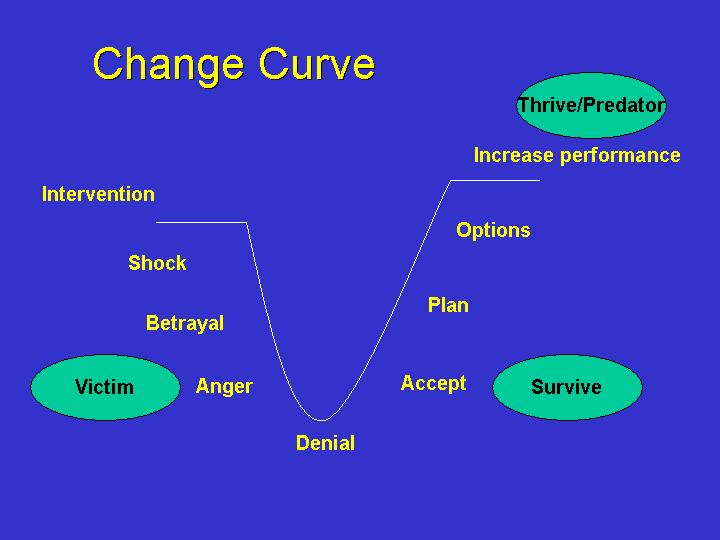 Too often "The Dungeon of Denial" is where people tend to dwell when going through a difficult period of change.
Have you ever challenged someone when they are in denial?
What is the usual response?
"No I am not!"
Saturday, October 21, 2006
Situational Leadership II Mind Map
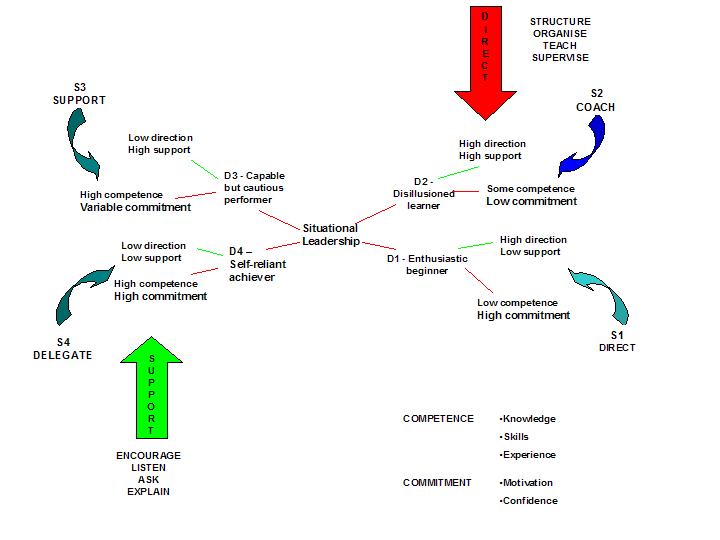 For those of you who have studied Situational Leadership, here is a Mind Map of the key areas to remember. The Development Levels - D1 to D4. The Leadership Styles S2 to S4 and the descriptors of the levels of Competence and Commitment in each Development Level.
Training Delivery
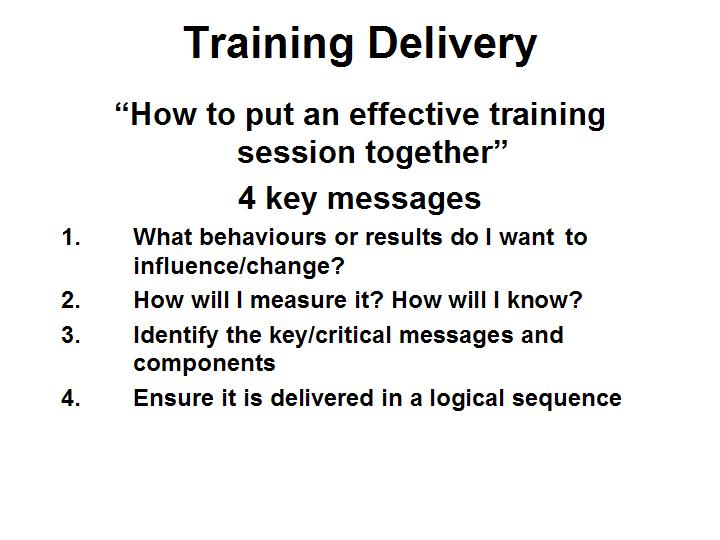
Begin with the end in mind. What behaviours or results do you want to influence or change?
What processes and measures will you put in place to confirm the success of the training?
Ensure that it is delivered in a logical sequence. Think about your audience and remember the saying "I hear - I forget. I see - I remember. I do - I understand." You will have a mixture of learning styles within your audience, therefore it makes sense to integrate a variety of learning delivery to accommodate those styles.
Too much theory may put off the Pragmatists* (who prefer to learn when there is a link between the subject and implementing on the job)) and Activists* (those who prefer to try new and different things. They like action based learning). Launching people straight into role-plays and getting them involved in the "doing" with minimal input may not be the best way of engaging the Theorists* (who need to explore and test theories before implementation. They are rational and logical) and Reflectors* (who prefer to observe first and think about what they have learned before application).
Think about your audience in respect of their "Readiness" for the the training. Where are they in relation to their Competence - (Knowledge, Skill and Relevant Experience) and Commitment - (Confidence and Motivation)?
Have you linked the training to your diary and is it relevant to what is happening now in the business?
Thursday, October 12, 2006
Active Listening (courtesy Anne Marie Sheridan)
Active Listening:
You can actively listen by using the following:
Non-verbal noises:
Allow the speaker to know that you are really listening to what they are together with the appropriate facial expression – a smile for example, head movement, body posture. The skilled use of these ‘hmm’ ah oh uhh can encourage the speaker to speak indefinitely
Supportive statements
These are the verbal equivalent of non-verbal noises. These are ways of saying ‘I’m with you’… keep going.
You can also use listening questions to support the speaker… can you give me an example? It seems as though?
Key word repetition
If you really are listening these can be picked up and can be used to encourage the speaker
Reflective statements
This is used to help the speaker see that you are with them and that you want to add on to what they have said. The most usual form of reflection is expressed as a statement and tends to begin with ‘you feel that…?’ ‘it seems to me that?’ These words indicate to the speaker that you are interpreting the emotional undertones of what is being said – and you are putting your finger on the deeper emotions behind the words and showing a real understanding of speaker’s feelings.
Physically demonstrate that you are listening:
This shows the speaker that you are ‘with’ them. Consider how you feel if you are talking to someone and they appear to be half asleep… who don’t look like they are listening. The trick in attending physically is to let people see that you are listening.


