
Saturday, December 09, 2006

Six Paradigms of Human Interaction
I have just been having a look at Dr Stephen R Covey's book - The 7 Habits Of Highly Effective People (again) and in particular the above section, which I thought was worth sharing with you.
- Win/Win - and I quote - "Is a frame of mind and heart that constantly seeks mutual benefit in all human interaction. Win/Win means that agreements or solutions are mutually beneficial and mutually satisfying."
- Win/Lose - "In leadership style, Win/Lose is the authoritarian approach: " I get my way, you don't get yours." Win/Lose people tend to use their position, power, credentitals or personality to get their way.
- Lose/Win - "Maybe worse than Win/Lose because it has no standards, no demands or expectations or vision." Lose/Win is usually used by people who are eager to please or appease. They seek strength from popularity or acceptance (probably Lose/Win will be evidenced more in Amiables and possibly Expressives rather than Drivers and Analyticals - see previous postings). Lose/Win people bury a lot of feelings, and unexpressed feelings never die. They may manifest themselves later in ugly ways. People who are constantly repressing, rather than transcending feelings towards a higher meaning find that it affects the quality of their self esteem and subsequently the quality of their relationships with others."
- Lose/Lose - "When two Win/Lose people interact, the usual result will be Lose/Lose Both will lose." Dr Covey quotes an example of a particualrly acrimonious divorce case where the husband was directed to sell his assets and turn over 50% of the proceeds to his ex-wife. So he sold his $10,000 car for $50 and gave $25 to his wife! When his ex-wife protested the judge discovered that he was doing the same with all his other assets!
- Win - People with the Win mentality don't necessarily want others to lose, they just want their own way and will leave it up to others to get theirs.
Which of these five is best? Well it does rather depend doesn't it?
You can't play a football match with a Win/Win mentality can you?
Often companies have incentives and prizes which means someone wins and someone loses.
If you value a relationship and the issue is not that important you may go for Lose/Win in some circumstances to genuinely affirm the other person.
Sometimes you would just want to Win. If, for example, there was a natural disater and your child's life was in danger, you would be concerned about the other people who may be at risk, but saving your child would be your sole aim.
"The best choice." says Covey "depends on reality. "The challenge is to read that reality correctly and not to translate Win/Lose or other scripting into every situation."
"Most situations are part of an interdependent reality and then Win/Win is really the only viable alternative of the five."
The sixth option is:
- Win/Win or No Deal - "which basically means that if we cannot find a solution that would benefit us both, we agree to disagree, agreeably."
Extract from The 7 Habits Of Highly Effective People by Dr Stephen R Covey
Friday, December 08, 2006
Measuring Impact Of Your Training
Assessment or Evaluation?
Training has 2 key parts:
1. The quality of the training that has taken place. Have the participants enjoyed it? What excercises were used? What was the quality of the venue like? The quality of these can be assessed by completing questionnaires and talking and listening to the participants feedback.
2. And more importantly, the quality and value of what people have learnt as a result of the intervention. What learning has taken place? Have the people changed as a result and what will they will do differently that will be of personal benefit to them in terms of their own behaviour and performance and what does it mean to the bottom line of the organisation. The value of these can be evaluated.
Sunday, November 05, 2006
Social Styles - Some snippets

Here are some descriptors around the social styles that we discussed in a previous blog. Just to remind you, the horizontal axis that runs through the middle of the grid is Assertiveness - which is "The perceived effort that a person makes to influence others" - The vertical axis represents Responsiveness - which is "The perceived freedom with which a person shows his or her feelings or responds to the feelings of others" Someone who is perceived as "Tell" Assertive would be seen as "More" Assertive and someone who was "Ask" Assertive would be seen as "Less" Assertive.
 Someone who is perceived as "Tell" Assertive would be seen as "More" Assertive and someone who was "Ask" Assertive would be seen as "Less" Assertive.
On the Responsive scale. At the top end "Controls" would be seen as "Less" Emotionally Responsive (Cooler) while someone at the bottom end "Emotes" would be seen as "More" Emotionally Responsive (Warmer).
It should be noted that there is no one best place to be. Each style has it strengths and weaknesses.
For example, someone who is perceived as a Driving Style (More Assertive & Less Responsive) could be perceived as a Candid "Tell it like it is" type of person. If this strength was overused it may come across as Abrasive.
Someone who is perceived as an Expressive Style (More Assertive & More Responsive) could be perceived as Fun Loving "Life & soul of the party" type, which if overused could be seen as Irritating.
A strength of the Amiable Style (Less Assertive & More Responsive) is their Diplomacy, which overused could be perceived as a Conflict Avoider (some may say Wimp!)
The Analytical Style (Less Assertive & Less Responsive) is respected for their Systematic Approach which overused could come across as Bureaucratic.
The style that is diametrically opposed to your own is the one that will require you to exercise your people skills when influencing and responding to them.
The second slide indicates the primary need for each style, their orientation and their growth action or development need. (From Personal Styles & Effective Performance, by David Merrill and Roger Reid)
Thursday, November 02, 2006
Nick's Grammar Slammer (Part 2)
Along with Eats, Shoots and Leaves - this is great!
Possessives
The ending 's is used to indicate the singular possessive of any word that does not end in s:
President Bush's victory
The monkey's nuts.
For the possessive of singular words that end in s, the traditional rule is to use 's:
Pythagoras's principle
Mr Jones's letter.
However, some writers now adopt a more streamlined approach and prefer a bare apostrophe for all words ending in s. For example:
Jacques Delors' limousine
Boris' faux-pas.
Note that the possessive form of it does not take an apostrophe - in fact, the only personal possessive pronoun with an apostrophe is one's.
The dog was chasing its tail.
Use a bare apostrophe for regular plural possessives:
The families' cars
The doctors' conference.
For irregular plurals, use 's:
The men's room
Sheep's eyes.
Elision
The apostrophe is also used to indicate that part of a word (or words) is missing. Examples are I've, didn't, can't, it's and doesn't.
Plurals
Never use apostrophes to make a plural.
Not three book's but three books
Not six MP's but six MPs
Not the 1990's but the 1990s.
However, some people argue that apostrophised plurals should be allowed where they make the meaning clearer. For example, how would you write p's and q's, or do's and don'ts? But as a general rule, the grocer's plural is unmatched in its power to undermine the credibility of both message and writer.
Contributor: Jane Smith & Nick Smith
Gorillas and Bananas
The Gorillas and the Bananas Story
An experiment was conducted with four gorillas who were moved into the same cage. When the gorillas were first introduced into the environment, the experimenters would lower bananas into the centre of the cage. When the gorillas went after the food, all were hosed down with a high-pressure water hose. Even if only one went after the food, all received the same treatment.
As expected, soon the gorillas did not go after the bananas when they were lowered into the cage. Behaviour was trained and reinforced.
Now, the experimenters replaced one of the gorillas.
When the bananas were lowered into the cage, the new gorilla, of course, started toward the free meal. The other three gorillas knew what would happen, so they quickly jumped the new gorilla, keeping him from causing the dreaded response of water,
Although perplexed, the new gorilla quickly learned not to go after the food lowered into the cage, and to jump any other gorilla that did the same.
The experimenters continued by slowing replacing each gorilla one by one. The result was the same: the new one went for the food the others jumped him.
Soon the experimenters had replaced all of the four original gorillas. Keep in mind that the high-pressure water hose had not been used since the first four gorillas were together. But every time a new gorilla went for the food lowered into the cage, the others stopped him cold.
The experimenters were able to go several generations away from the original four gorillas, but still the behaviour did not change. None of the gorillas knew why they shouldn’t go for the food, but they knew what to do if any one did. It was what was done before them, and before them, and so on. A proud tradition was born.
You ever heard the response when some one asks "Why did you do that?"......
"That's the way we do things round here."
Lesson: Behaviour is learned
Acknowledgement - Stuart Emmett
Thursday, October 26, 2006
The Change Curve
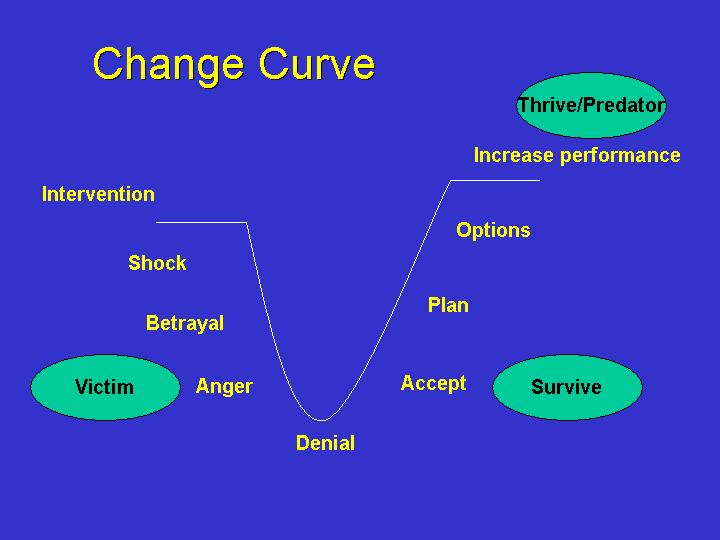 Too often "The Dungeon of Denial" is where people tend to dwell when going through a difficult period of change.
Have you ever challenged someone when they are in denial?
What is the usual response?
"No I am not!"
Subscribe to:
Comments (Atom)


