The Indispensable Man - A litttle reminder for those who think they are!
Sometime when you’re feeling important,
Sometime when your ego’s in bloom,
Sometime when you’re feeling quite certain,
You’re the best qualified in the room.
Sometime when you feel that your going,
Would leave an unfillable hole,
Just follow this simple instruction
And see how it humbles your soul.
Take a bucket and fill it with water,
Put your hand in it up to the wrist,
Take it out and the hole that’s remaining
Is the measure of how you’ll be missed.
Wednesday, October 11, 2006

Tuesday, October 10, 2006
Leadership Quotes
Having the power to get things done My Way, the captain’s way, can be exhilarating, and seductive. It is also terribly limiting. It limits the team to being the reflection of the one in charge. ~ Jim Thompson, Shooting in the Dark
Anyone can become angry – that is easy. But to be angry with the right person, to the right degree, at the right time, for the right purpose, and in the right way – this is not easy. ~ Aristotle
God grant me the serenity to accept the people I cannot change, the courage to change the one I can, and the wisdom to know it's me. ~ Author Unknown
Individual commitment to a group effort: this is what makes a team work, a company work, a society work, and a civilisation work. ~ Vince Lombardi, Former Green Bay Packers Coach
Simply doing more of what worked in the past - will be too incremental. More than that, it will be too slow. The winners of the future will be those who can develop a culture that allows them to move faster, communicate more clearly, and involve everyone in a focused effort to serve more demanding customers. ~ Jack Welch, General Electric Company
Blessed are the flexible, for they shall not be bent out of shape. ~ Michael McGriff, M.D.
There is only one time that is important – NOW! It is the most important time because it is the only time that we have any power.” ~ Leo Tolstoy
Far better it is to dare mighty things, to win glorious triumphs, even though chequered by failure, than to take rank with those poor spirits who neither enjoy much nor suffer much, because they live in the grey twilight that knows not victory nor defeat. ~ Theodore Roosevelt
Excellence is doing ordinary things extraordinarily well. ~ John W. Gardner
Dependent people need others to get what they want. Independent people can get what they want through their own efforts. Interdependent people combine their own efforts with the efforts of others to achieve their greatest success. ~ Stephen Covey
The best executive is the one who has sense enough to pick good men to do what he wants done, and self-restraint to keep from meddling with them while they do it. ~ Theodore Roosevelt
A leader is best when people barely know he exists, not so good when people obey and acclaim him, worse when they despise him. But of a good leader who talks little when his work is done, his aim fulfilled, they will say: We did it ourselves. ~ Lao-Tzu
The boss drives people; the leader coaches them. The boss depends on authority; the leader on good-will. The boss inspires fear; the leader inspires enthusiasm. The boss says "I"; The leader says "WE". The boss fixes the blame for the breakdown; the leader fixes the breakdown. The boss says, "GO"; the leader says lets, "GO!" ~ H. Gordon Selfridge
Too many managers don’t realise that when you become truly participative, you get into a lot of uncomfortable conversations in which you hear things about the situation and about yourself that you might not like. ~ Peter B. Vaill, Managing as a Performing Art
One of the true tests of leadership is the ability to recognise a problem before it becomes an emergency. ~ Arnold Glasow
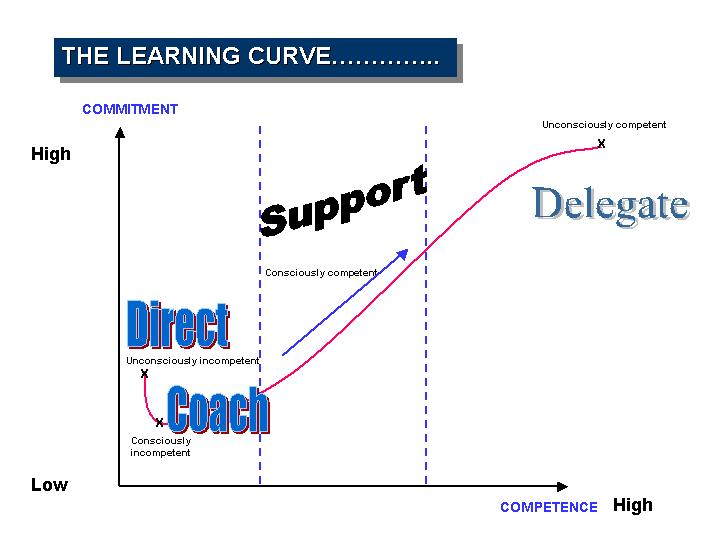
The Learning Curve: I use this model extensively when working on Leadership Development and delivering the principles of Situational Leadership. The measures are Commitment & Competence and the four key points in the journey towards competence are: Unconsciously Incompetent (you don't know what you don't know): Consciously Incompetent (The light switch has gone on! You realise you are not as good at this as you thought!): Consciously Competent (You have to think about what you are doing): Unconsciously Competent (The task has become second nature to you).
You will notice that at each point the leadership style needs to change. At the first point on the learning curve (Unconscious Incompetence), you need to be Directed, given clear instructions, shown what to do and when and closely monitored and supervised.
At the second point, when you realise that you are not as good as you think you are (Conscious Incompetence), the Leadership style needs to change slightly with less tell and more asking questions.
As the Leader, you would still own the task or goal and the responsibility for helping the follower to climb the learning curve. Here you would provide high direction, but your supportive behaviour would increase , this is known as Coaching style.
As competence increases to Conscious Competence, the direction diminishes and the Support increases. Eventually you become Unconsciously Competent and are able to perform the task with little or no supervision. Here the Leadership style changes to Delegating, which provides low direction and low support and allows the self reliant person to get on with the task.
One of the dangers is of course slipping back into Unconscious Incompetence.
Think about these 4 stages as learning to drive a car.
How many of you would pass your driving test if you had to take it again tomorrow morning at 9 a.m.? Not many I would imagine, as you have (and I have), picked up some bad driving habits along the way. Might it not be the same with everyday tasks we perform at work and at home?
Training:
Training refers to the acquisition of knowledge, skills, and competencies as a result of the teaching of vocational or practical skills and knowledge that relates to specific useful skills. It forms the core of apprenticeships and provides the backbone of content at technical colleges and polytechnics. Today it is often referred to as professional development.
Physical training is more mechanistic: planned suites of regimes develop specific skills or muscles with a view to peaking at a particular time. A specialized field of training often used in sports is autogenic training. Another type of training is fartlek training which is a flexible training type which can be adapted to suit almost any athlete.
Many early American astronauts trained extensively in Iceland's central highlands due to its similarity to an extraterrestrial planet.
Training & Development is the field concerned with workplace learning to improve performance. Such training can be generally categorized as on-the-job or off-the-job. On-the-job describes training that is given in a normal working situation, using the actual tools, equipment, documents or materials that they will use when fully trained. On-the-job training is usually most effective for vocational work. Off-the-job training takes place away from normal work situation which means that the employee is not regarded as productive worker when training is taking place. An advantage of off-the-job training is that it allows people to get away from work and totally concentrate on the training being given. This is most effective for training concepts and ideas.
In military use, training means gaining the physical ability to perform and survive in combat, and learning the many skills needed in a time of war. These include how to use a variety of weapons, outdoor survival skills, and how to survive capture by the enemy, among others. See military education and training.
In religious and spiritual use, training means purifying mind, heart, understanding and actions to obtain a variety of spiritual goals such as closeness to God or freedom from suffering. Typical of institutionalized spiritual trainings is the Buddhist Threefold Training.
Retrieved from "http://en.wikipedia.org/wiki/Training"
Categories: Training Education
Leadership Development:
In organizational development, leadership development is the strategic investment in, and utilization of, the human capital within the organization.
David Day (2001) distinguished between leader versus leadership development.
Leader development focuses on the development of the leader, such as the personal attributes desired in a leader, desired ways of behaving, ways of thinking or feeling.
In contrast, leadership development focuses on the development of leadership as a process. This will include the social influence process and the team dynamics between the leader and his/her team at the dyad level, the contextual factors surrounding the team such as the perception of the organizational climate and the social network linkages between the team and other groups in the organization.
Both forms of development may mutually influence each other, as exemplified in the concept of "Deep Change" in Robert E. Quinn's 1996 book of the same title.
Typically, leader development has focused on 3 main areas - providing the opportunities for development, stimulating the ability to develop (including motivation, skills and knowledge for change), and providing a supportive context for change to occur (see Cynthia D. McCauley, 2001).
Leadership development can build on the development of individuals (including followers) to become leaders. In addition, it also needs to focus on the interpersonal linkages between the individuals in the team.
In the belief that the most important resource that an organization possesses is the people that comprise the organization, some organizations address the development of these resources (even including the leadership).
Leadership development can encompass any number of developmental processes including:
talent identification and management
individual development planning
management development
360-degree feedback
succession planning
mentoring
coaching
Conflict Style Inventory
[edit]
References
David V. Day (2001). Leadership Development: A review in context. The Leadership Quarterly, 11, 581-614.
Cynthia D. McCauley(2001). Leader training and development. In The nature of organizational leadership. San Francisco: Jossey-Bass.
Robert E. Quinn (1996). Deep change: Discovering the leader within. San Francisco, CA: Jossey-Bass.
[edit]
External links
Conscious Leadership
Leadership Simulator
Carter McNamara's Free Online Library
Governance Focus issues in governance worldwide, in English & Español
Leadership Development WIKI
Retrieved from "http://en.wikipedia.org/wiki/Leadership_development"
Kenneth Blanchard is an American businessman, as well as a consultant, speaker, trainer, and author on management and leadership.
He owns the Ken Blanchard Companies, a family-owned business in San Diego, California, and is well-known for developing the Blanchard and Hersey Model of situational leadership theory, together with Paul Hersey. He and others have extended it as Situational Leadership® II. With Spencer Johnson, he developed the One Minute Manager concept, and co-authored a series of books on it. His One Minute Manager Library has collectively sold more than 7 million copies and has been translated into more than 20 languages. He has also tied in Situational Leadership with team development, which he calls Highly Performing Teams.
Dr. Blanchard received his B.A. from Cornell University in government and philosophy, an M.A. from Colgate University in sociology and counseling, and a Ph.D. from Cornell in educational administration and leadership. He maintains a faculty position as Professor of Leadership and Organizational Behavior at the University of Massachusetts Amherst and a visiting lectureship at Cornell University, where he is also an elected member of the Board of Trustees.
He has been a guest on a number of national television programs, and has been featured in Time, People, US News & World Report.
Contents[hide]
1 Works
2 In Education
3 References
4 External links
Friday, October 06, 2006
A Nasty Internet Experience! Beware of SpyNoMore.com
On Sunday, 1st October my PC was infected with a virus which took over my home page and slowed my computer down considerably.
I did a Yahoo search to find the best spyware remover and was led to SpyNoMore. They offered a free scan of your computer but you had to pay for the removal of the spyware. The scan revealed 84 infections! I bought a 3 machine licence (I have 2 laptops as well as the PC) for $39.95 + tax.
When I paid SpyNoMore sent me a registration number to activate the download and to remove the offending viruses. Unfortunately when I entered the registration number I got the message "Invalid Receipt Number". I contacted their Help Desk over the Internet and within a couple of hours got a message to tell me to uninstall the programme and then reinstall it and all would be fine. Hmmm! Not so. I did as they asked and got the same message.
I tried 5 times altogether and still received the same message. I did get one further message from the Help Desk basically telling me to do the same again. Since then, I have sent a further 6 or 7 messages asking for help and have not had one reply!
So anyone who reads this I would strongly urge you not to be fooled by SpyNoMore. They are charlatans! I have also complained to Clickbank who authorised the payment and they have replied and said that they have no record of such payment, yet my bank statement clearly indicates that it went through them.
Be warned DO NOT PURCHASE SPYNOMORE!!!
Subscribe to:
Comments (Atom)


